Inner Compass is the foundation everything else here builds on.
It’s a simple way of describing how people actually change: moving from stability, to clarity, to expression.
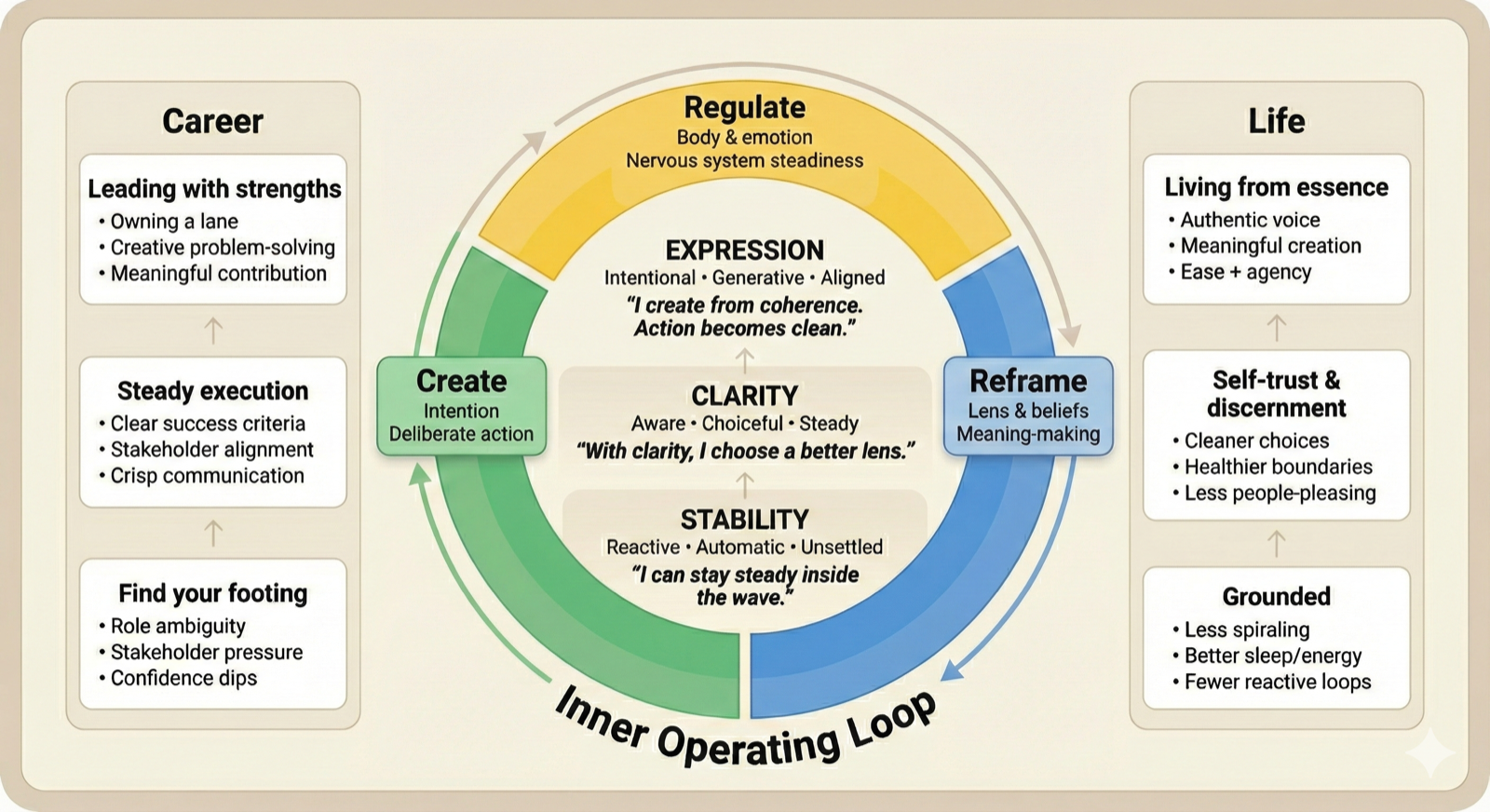
Each stage builds something real, not just insight: steadier footing, a clearer read on what’s actually happening, and the ability to act on it on purpose instead of by reflex.
The sequence runs whether you notice it or not.
Here’s how it plays out day to day. Something happens: a comment in a meeting, an email that lands wrong, a decision you have to make on the spot. You interpret it before you’ve even noticed you’re doing it, and that interpretation produces a feeling.
The feeling drives what you do next, and what you do next becomes part of how you experience yourself, the people around you, and what you think you’re capable of.
Most of the time, this whole sequence runs on its own, the same way it always has, without you choosing it.
- Event
- Interpretation
- Emotion
- Action
- Experience
This is the sequence running underneath almost everything you do, most of the time without you noticing.
The goal isn’t to stop it, since you can’t and wouldn’t want to. It’s to catch it early enough to get a real say in how it plays out. That’s what stability, clarity, and expression actually do: stability means the reaction doesn’t run the whole show, clarity means you can see what’s actually happening instead of the story you’ve told yourself about it, and expression means you can act from that place instead of just reacting your way through it.
Many maps, one pattern
None of this is new. The same pattern shows up, described differently, across a lot of traditions and disciplines: stability before clarity, clarity before real expression. If you already think in one of these frameworks, you’ll probably recognise it:
- The Hero’s Journey (descent, ordeal, return)
- Maslow’s Hierarchy of Needs (from safety to fuller self-realisation)
- The chakra tradition (a symbolic arc from grounding to expression)
- Cognitive and behavioural models (how interpretation shapes emotion and action)
If this kind of exploration is something you want to take further, beyond how it shows up in your work and relationships, that’s what Ganga Tattva is for.
Inner Compass is less a label to put on yourself, and more a way to orient. Once you can see the sequence you’re actually running, you can start changing your next step in it, a little at a time, without forcing anything.
Want to know which part of the sequence is running you?
Takes about three minutes.